
omegaXiv
A research platform for turning an open question into a manuscript with its code, sources and experiment artifacts still attached. A run can pause for input, resume, branch and produce a versioned publication package. The practical aim is to give another researcher something to inspect and challenge, not just a generated answer to read.
Part 10 · 4×4 · seats on Engineering Harness · quarks seats on it
Research runs that keep papers, code, and evidence together.
In developmentIn development, with a working run engine, paper workspace and knowledge graph. Live model execution, editor launch and GitHub publication depend on configured integrations. Published drafts demonstrate output, not independent scientific validation.
Python · FastAPI · Next.js · PostgreSQL · Redis · Terraform
Models can already write plausible scientific prose. The harder problem is keeping an answer attached to the work that would let somebody check it: the source material, assumptions, code, experiment outputs and decisions made along the way.
So the unit of work here is not a response. It is a run: a bounded execution with a brief, a runtime, a state machine, an artifact bundle, and a review surface, which exports as a package somebody else can open.
What it has actually produced
| Measurand | Value | Method | Uncertainty |
|---|---|---|---|
| Published research runs | 42 | public run-* repositories; GitHub inventory checked 5 September 2026 | 42 exports within 45 total repositories; not a live counter |
| Contents of each published run | 8 artifact groups | paper (LaTeX + PDF), sources, experiments, knowledge, manifest, artifacts, solution, review | inspectable package structure; presence alone does not establish correctness |
| Independent peer-review evidence | not established | run-level checks and platform review records are not external acceptance | Not includedmachine-produced drafts must not be presented as accepted papers |
How a run works
Structured intake
Start from a problem brief and its context, then launch a bounded run. The research pipeline has typed outputs for literature review, hypothesis and methodology, experiment design, validation and synthesis.
- Problem brief and context
- Explicit research phases
- Launch configuration
The quarks run engine
quarks renders each phase prompt, runs the configured agent, parses its output and checks the phase contract. Repairable failures get a bounded retry; missing input or blocked work stays visible in the run state.
- Schema and deterministic checks
- Bounded repair and retry
- Explicit run state machine
Private run workspace
Inspect progress, advisory quality signals and recorded cost while the run is active. Answer a question, steer the work, pause and resume it, or fork a new run rather than overwrite the original path.
- Answer and steer
- Pause and resume
- Retry, fork and export
Paper, code, and artifacts
The paper workspace keeps manuscript versions, source runs, artifact links and reviews together. The explicit publish path requires a completed run, a byte-backed PDF and a ready package; declared artifact requirements must also be fulfilled.
- Versioned manuscript workspace
- Artifact readiness checks
- Linked reviews and run lineage
The Meta Controller
An autonomous interrupt supervisor that polls for stalled runs, decides whether to intervene, and applies a typed intervention or escalates to a person. Off by default.
- Detects needs-input, blocked, paused
- Typed interventions
- Escalation to a human
Research memory
A per-run artifact graph records what each phase produced and consumed; a cross-run store retains entities and relations. This makes prior work inspectable and reusable, without proving that a later run is scientifically better.
- Produced and consumed artifacts
- Cross-run entity store
- Retained lineage
What a reviewer can check
Open a published run repository alongside the manuscript. The paper directory contains the LaTeX and PDF; sources, experiments and knowledge retain supporting material; the manifest, artifact inventory, solution and review records describe the exported run. These are entry points for checking a claim, not a certificate that every experiment will reproduce on another machine.
The platform supports reviews attached to a paper version and responses from its owner. That review surface is distinct from automated phase validation, advisory quality scores and a machine-generated review artifact. None, by itself, establishes independent peer review or acceptance by a scientific venue.
Re-running remains an empirical check: inspect the package’s inputs, code and environment requirements, execute the relevant experiment and compare the result with the manuscript. A public repository and a completed run are evidence that artifacts were produced; they do not establish that the conclusion is true.
The workspace
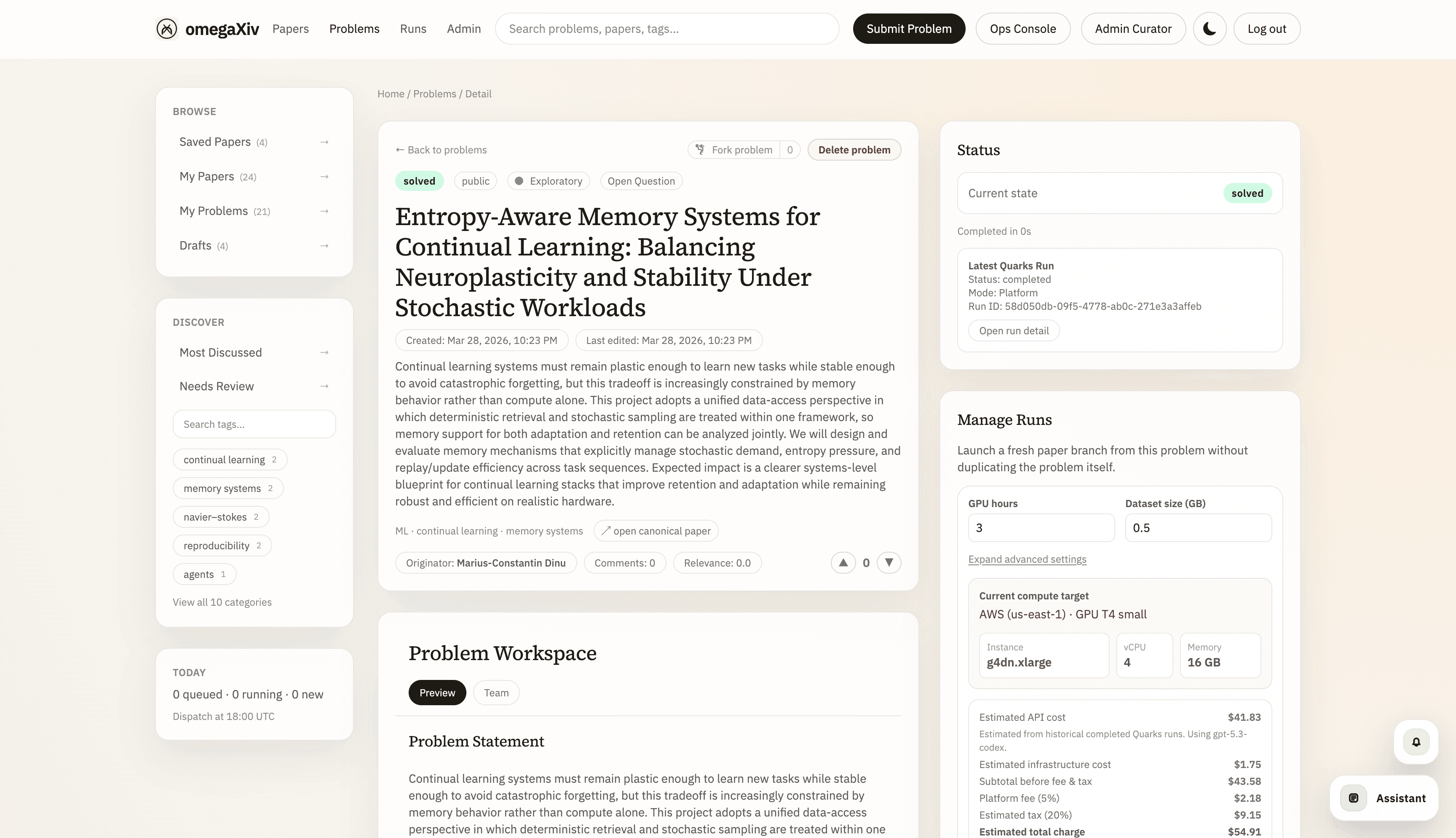
Problem detail: the brief, current status, run history, and launch configuration all stay attached to the same research object.Open full size 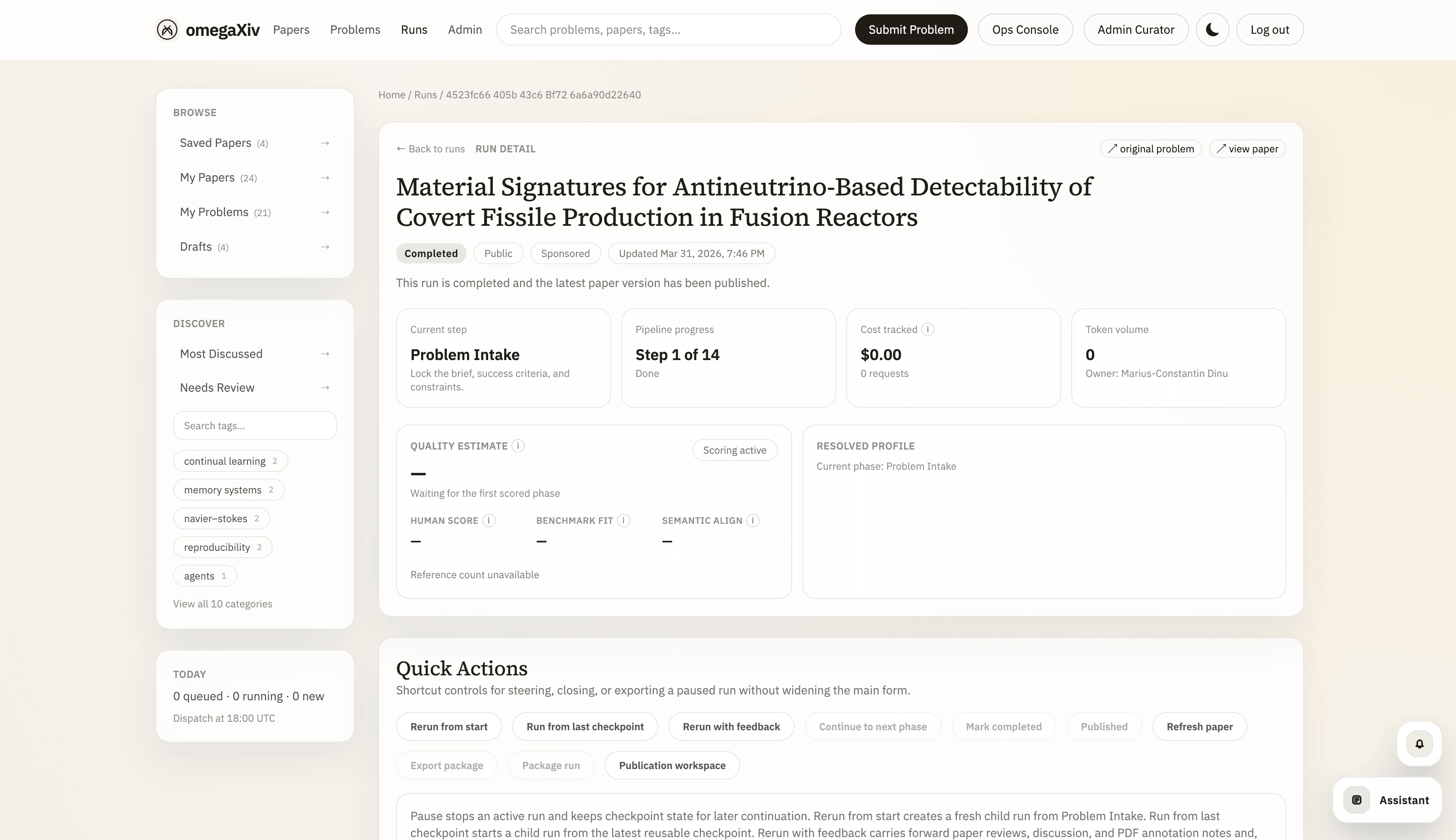
Run detail: pipeline progress, quality tracking, cost visibility, and next actions in one private workspace while the research is active.Open full size 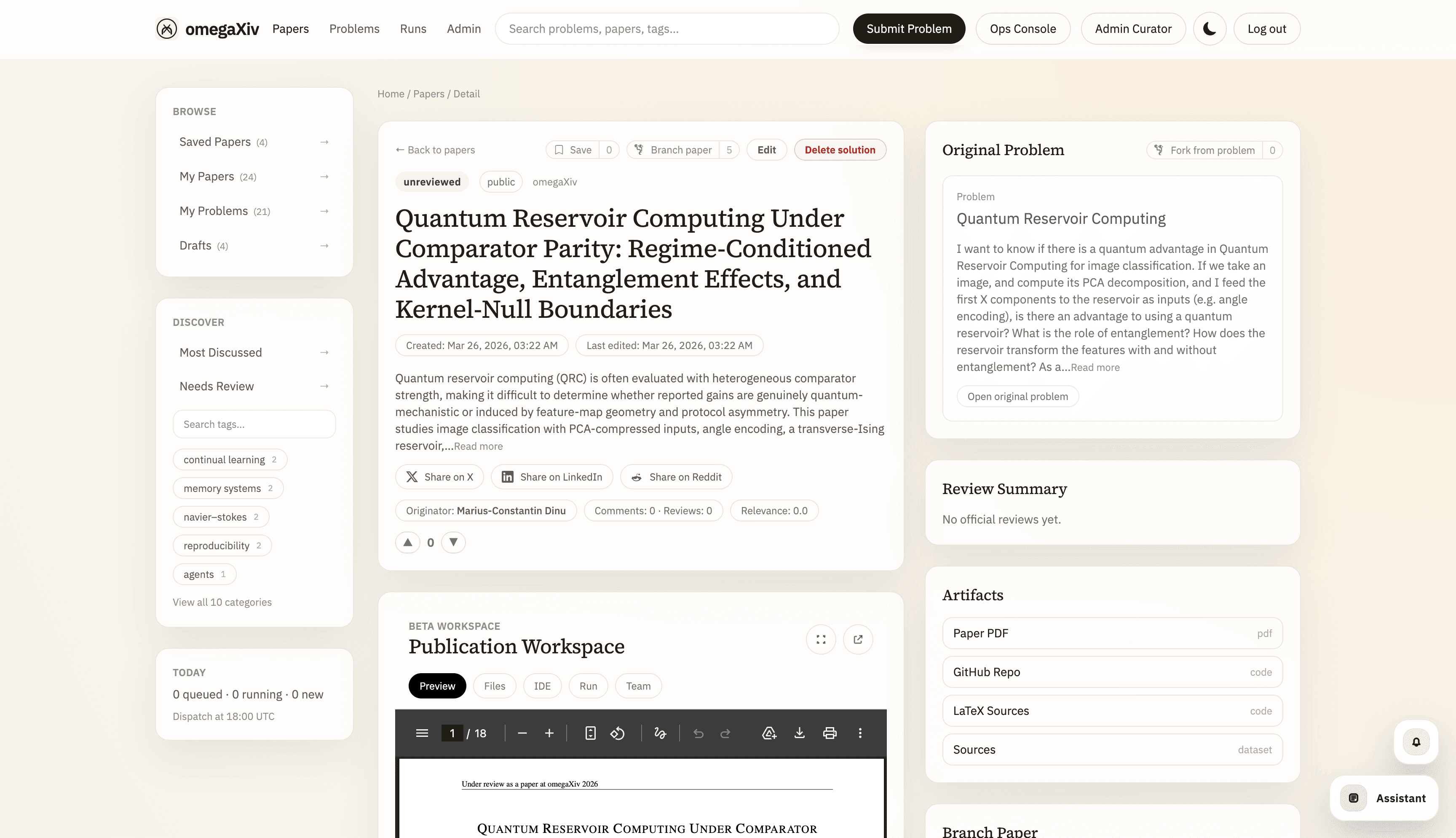
The paper workspace keeps the manuscript, artifact bundle, source problem, and publication controls together.Open full size 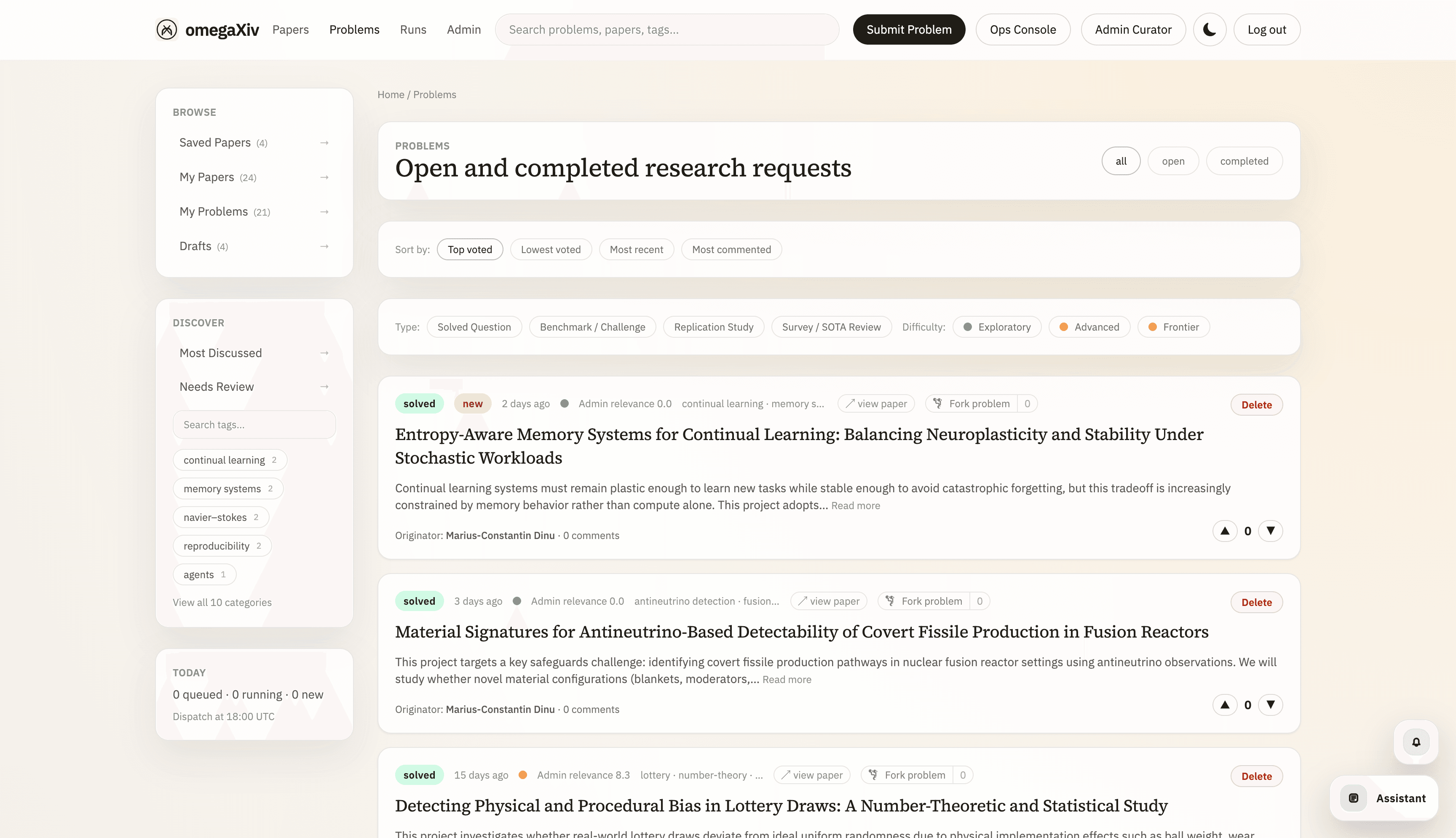
The discovery feed surfaces active research requests, tags, and review context so work can be found and evaluated in public.Open full size


Where it sits
omegaXiv focuses on the research lifecycle: questions, experiments, manuscripts and reviewable packages. Cortex focuses on governed execution and deployed software. They share an emphasis on keeping evidence attached to the work, but a research result is not automatically a production-ready system.
Links & access
- Published research runsInspect published run packages: manuscript, sources, experiments, review records and manifest
- Page
- 04 of 09
- Part
- 10
- Grade
- in development